

Biofouling is an especially serious issue in shellfish aquaculture, as it reduces water flow, can hurt the aesthetic value of a cultured product, and results in higher labor costs overall to deal with the fouling. Biofouling can clog the mesh of the gear in which the shellfish are grown, thereby restricting water flow, which means reduced oxygen and microalgae (food) delivery, directly reducing the growth and survival of cultured organisms. As a result, biofouling mitigation may account for as much as ~15% of total annual operating costs for shellfish growers in the US, with total costs exceeding $21 million.
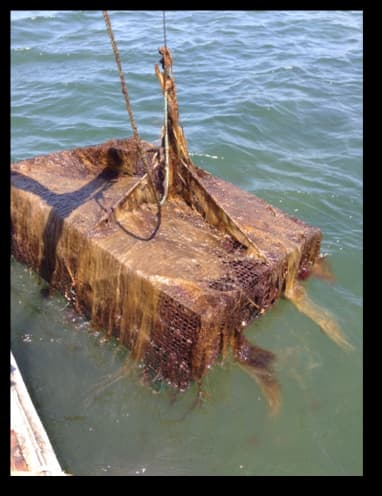
Preventing or reducing biofouling is one of the most pressing concerns for a shellfish farmer. There are many ways which have been proposed to deal with biofouling, though the best method would be to stop the fouling communities from ever becoming established. One method to reduce the settlement of member of the biofouling community is the use of biofoul-releasing non-toxic gear coatings. Biofoul releasing coating in shellfish aquaculture must be non-toxic to the shellfish, but have potential to reduce biofouling and larval settlement of biofouling community members by creating a slippery surface or by releasing compounds which deter or prevent settlement. Netminder (East Falmouth, MA) is a biodegradable, non-toxic, gear coating pt that has shown success in reducing biofouling on cages and nets in various aquaculture operations.
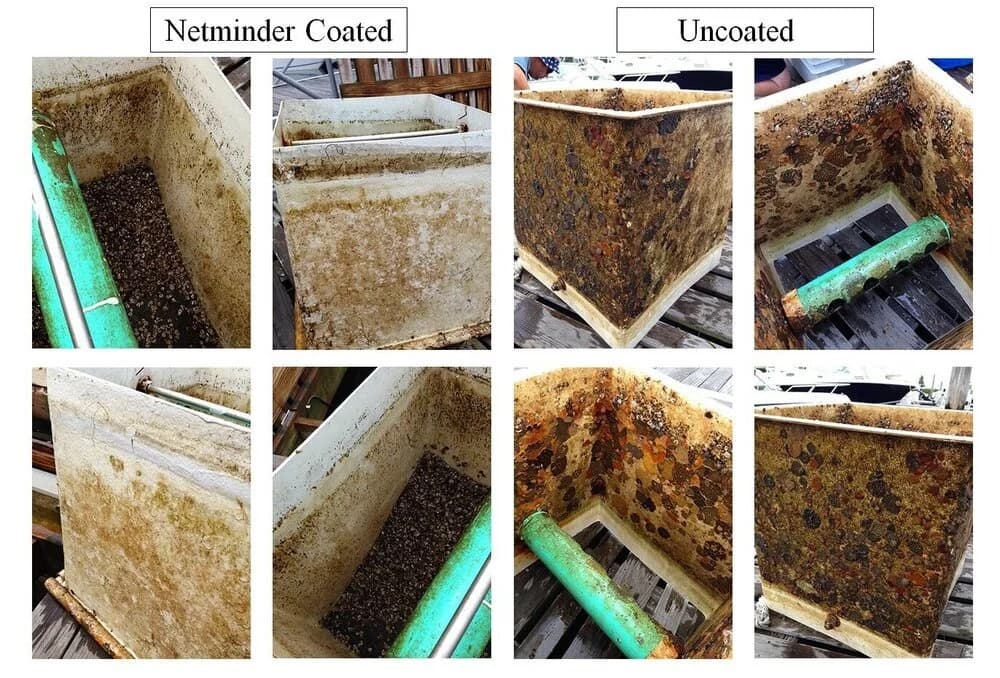
Ward Aquafarms has partnered Netminder since 2015. The first experiment conducted by Ward Aquafarms and Netminder investigated the efficacy of Netminder in preventing the settlement of biofouling community members on silos in oyster upweller systems. The results were very promising (see below image), with gear coated in Netminder revealing almost no settlement compared to gear which had no Netminder applied.
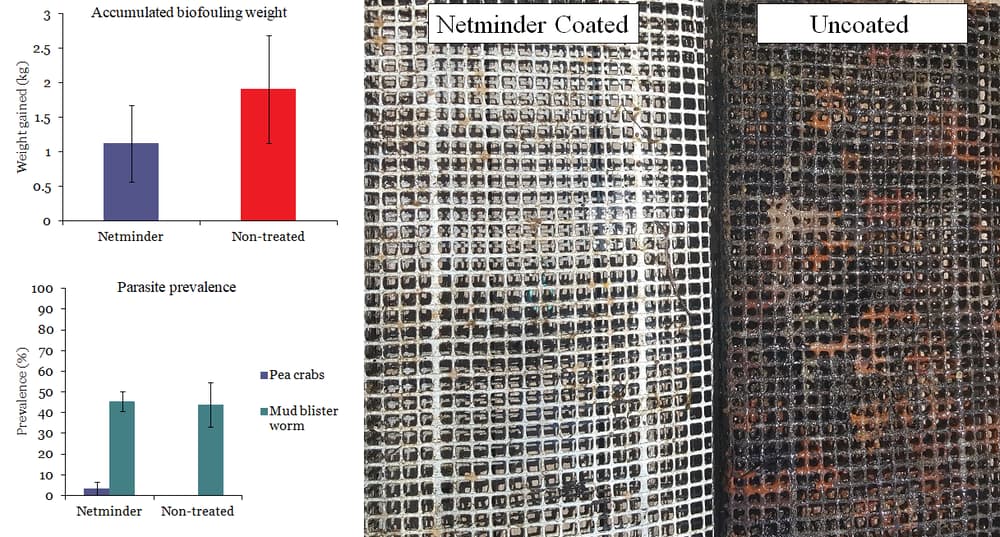
In 2017, Ward Aquafarms applied Netminder to gear housing bay scallops during an multi-month experiment which investigated if Netminder could be used as a technique to mitigate the prevalence of parasites of bay scallops.

Although Netminder appeared to have no impact on the settlement of parasites on bay scallops housed in gear coated in Netminder, the gear which was coated in Netminder has a significantly lower accumulation of biofouling (kg).
Netminder as a technique for predator avoidance in oyster aquaculture:
Results from this study will aid in the development of techniques to mitigate predation of starfish and oyster drill snails on cultured eastern oysters. Eastern oysters are a sessile invertebrate, meaning they are immobile and unable to move away from potential predators, such as starfish and oyster drill snails. Although much of the gear used in oyster aquaculture keeps oysters from being directly in the sediment, portions of the gear typically extend to the sediment, such as legs on cages or rebar racks in intertidal aquaculture. With oyster aquaculture gear extending to the sediment, organisms such as starfish and oyster drills are able to climb to the location of shellfish, such as oysters, housed in said gear. Since starfish and oyster drills typically have to come into contact with gear prior to having access to forage on aquacultured oysters, identify a gear coating that deters starfish and oyster drills will help decrease oyster mortality and increase production. Results from this study illustrate multiple coatings that could help in reducing predation by starfish and oyster drills on eastern oysters housed in aquaculture gear.
To test different experimental coating developed by ePaint, including Netminder, Ward Aquafarms ran two separate experiments. The fist experiment investigated if oyster drills were attracted or deterred by a gear coating when introduced to a mesocosm with gear coated in single experimental coating.
This objective was investigated using replicate 20 liter mesocosms filled with seawater which were equipped with air stones to provide oxygenation for the duration of each 24 hour trial. All trials were maintained at water temperature of approximately 20 degrees Celsius. Once the 20 liter buckets were filled, a cage with an ID number identifying the coating applied was added to each mesocosm.
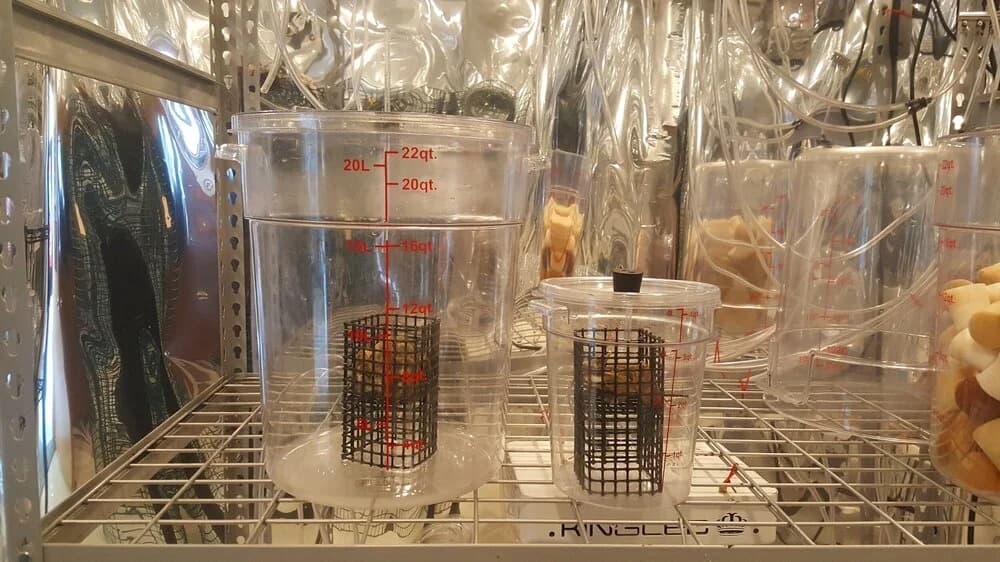
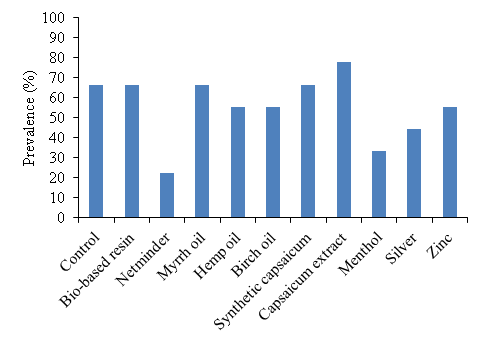
Average oyster drill prevalence on cages with different gear coatings used in the 20 liter mesocosm trials did not significantly vary (GLM-ANOVA, Chi-square, α=0.05, two-tailed, df = 10, n =88, p = 0.423, Figure 6), ranging from 22% prevalence on gear coated with Netminder to 78% prevalence on gear coated with capsaicum extract.
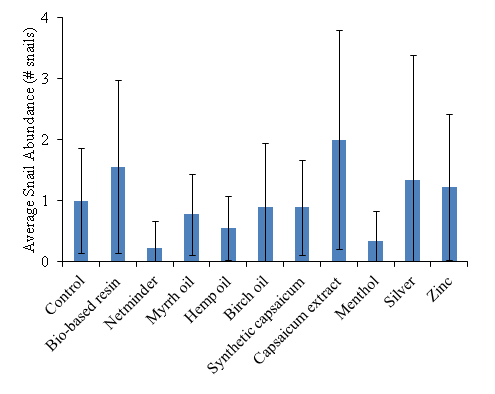
Average oyster drill snail abundance (average number of snails observed on a single cage) across all trials using 20 liter mesocosms ranged from 0.22 snails/cage (0 – 1 snails per cage) for cages coated in treatment Netminder to 2.0 snails/cage (0 – 5 snails per cage) for cages coated in treatment Capsaicum extract
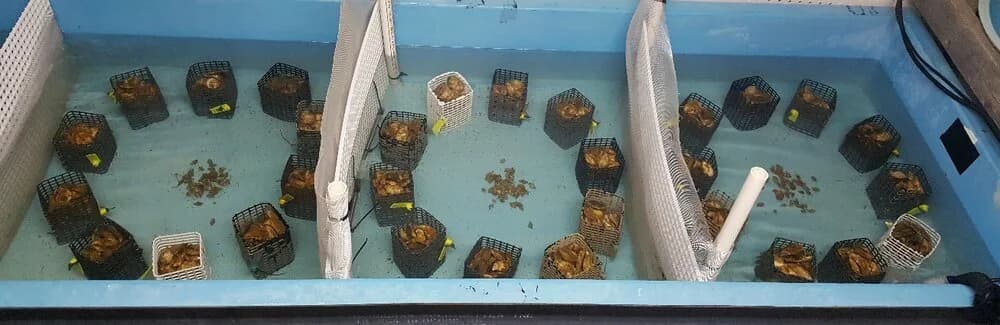
To further investigate the efficacy of different experimental gear coatings in mitigation predation on oysters, a choice trial was conducted using a 200 liter raceway system. The 200 liter raceway tank was provided with two water pumps to provide flow and two separate air stones to provide aeration at either end of the tank. The tank was held at 20 degrees Celsius for the duration of the experiment. Prior to placement of cages, oysters, and oyster drills, the raceway tank was separated into three sections.
In each section 10 randomly selected cages with different gear coatings were placed equidistant from each other in a circular pattern. Each cage was then filled with 200 ml of 1-2” year two oysters. Within the center of the circle of cages, 50 oyster drill snails were placed. After 24 hours of exposure to the oyster drills, the number of drills on the cages and the oysters within the cages were tallied. All snails were removed from the cages and oysters and placed back in the center of the cage circle. Measurements were taken every 24 hours for four treatments.
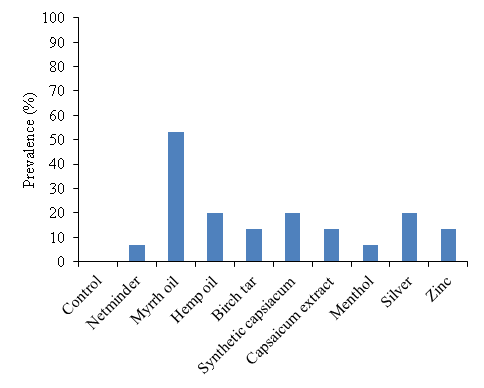
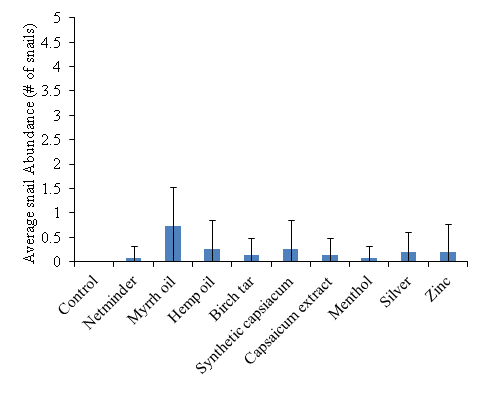
For the oyster drill snail choice trials conducted using the 200 liter raceway system, oyster drill prevalence ranged from 0% for the control to 53% for gear coated with myrrh oil. The only treatment which had an oyster drill snail prevalence that was significantly higher than any of the other treatments was the aforementioned 53% for gear coated with myrrh oil (GLM-TukeyHSD, Chi-square, α=0.05, two-tailed, df = 10, n =88, p = 0.0030)
Oyster drill snail abundance (average number of snails observed on a single cage) across all trials conducted in the 200 liter raceway system ranged from 0.0 snails/cage for cages coated in the control treatment group to 0.8 snails/cage (0 – 2 snails per cage) for cages coated in treatment myrrh oil
The same 200 liter raceway tank divided into three sections as used in objective three was used in objective four to test the if starfish were more attracted or deterred by different gear coatings when presented with cages housing oysters. The 200 liter raceway tank was again provided with two water pumps to provide flow and two separate air stones to provide aeration at either end of the tank and held at 20 degrees Celsius for the duration of the experiment. Prior to placement of cages, oysters, and oyster drills, the raceway tank was separated into three sections. In each section, 10 randomly selected cages with different gear coatings were placed equidistant from each other in a circular pattern. Each cage was then filled with 200 ml of 1-2” year two oysters. Within the center of the circle of cages, four 6” starfish were placed. After 24 hours of exposure of cages housing oysters to the starfish, the number of starfish touching the cage, on the cage and on the oysters within the cage were tallied. All starfish were the removed from the cages and oysters and placed back in the center of the cage circle. Measurements were taken every 24 hours for four treatments.
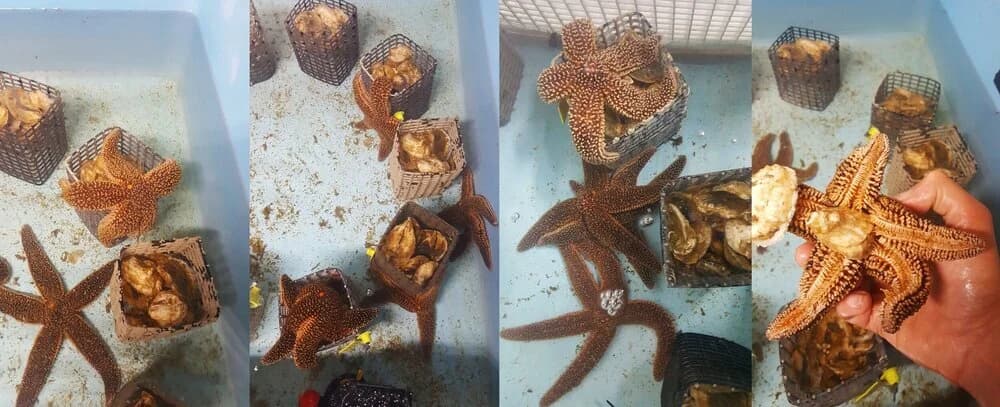
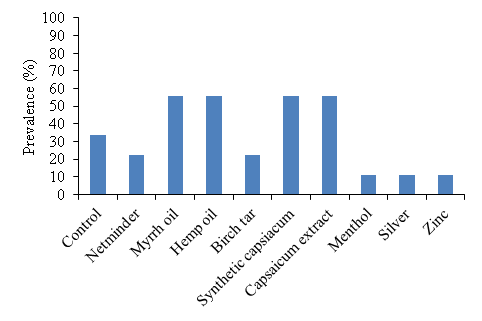
In the choice trials conducted with starfish in the 200 liter raceway system the prevalence of starfish on or touching a cage did not significantly vary between gear with different coatings, and ranged from 11% for menthol, silver, and zinc to 56% for treatments myrrh, hemp oil, synthetic capsaicum and capsaicum extract
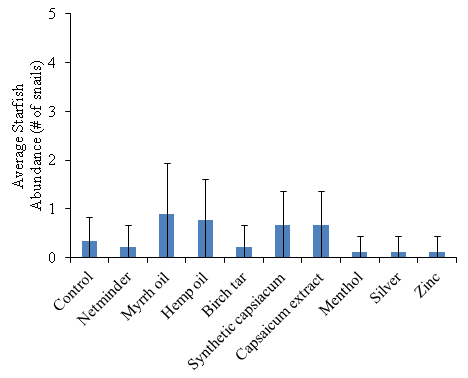
Starfish abundance (average number of starfish observed on or touching a single cage) across all trials conducted in the 200 liter raceway system ranged from 0.1 starfish/cage (0 – 1 starfish per cage) for cages coated in menthol, silver, and zinc to 0.9 starfish/cage (0 – 3 starfish per cage) for cages coated in treatment myrrh oil.
Results from this study suggest that the use of gear coatings developed by ePaint may be successful in mitigating predation on aquacultured shellfish. When gear was coated with the Netminder formula, oyster drill prevalence and abundance were significantly reduced compared to other treatments. Application of Netminder on aquaculture gear which houses eastern oysters in areas where oyster drill predation is common could help increase oyster survival and the revenue of the operation. In addition to mitigating oyster drills, results from this study suggest that menthol, zinc and silver could be potential options for reducing starfish predation on aquacultured eastern oysters. Although the observed reduction in starfish prevalence on gear coated with menthol, zinc and silver was not statistically significant, coating aquaculture gear in menthol, zinc and silver could have a significant impact if applied to gear on a commercial scale. Further investigation using field trials will help to further illustrate the impact of applied gear coatings in mitigating invertebrate predation on aquacultured shellfish such as the eastern oyster.
To learn more about Netminder and other ePaint products, visit ePaint.